
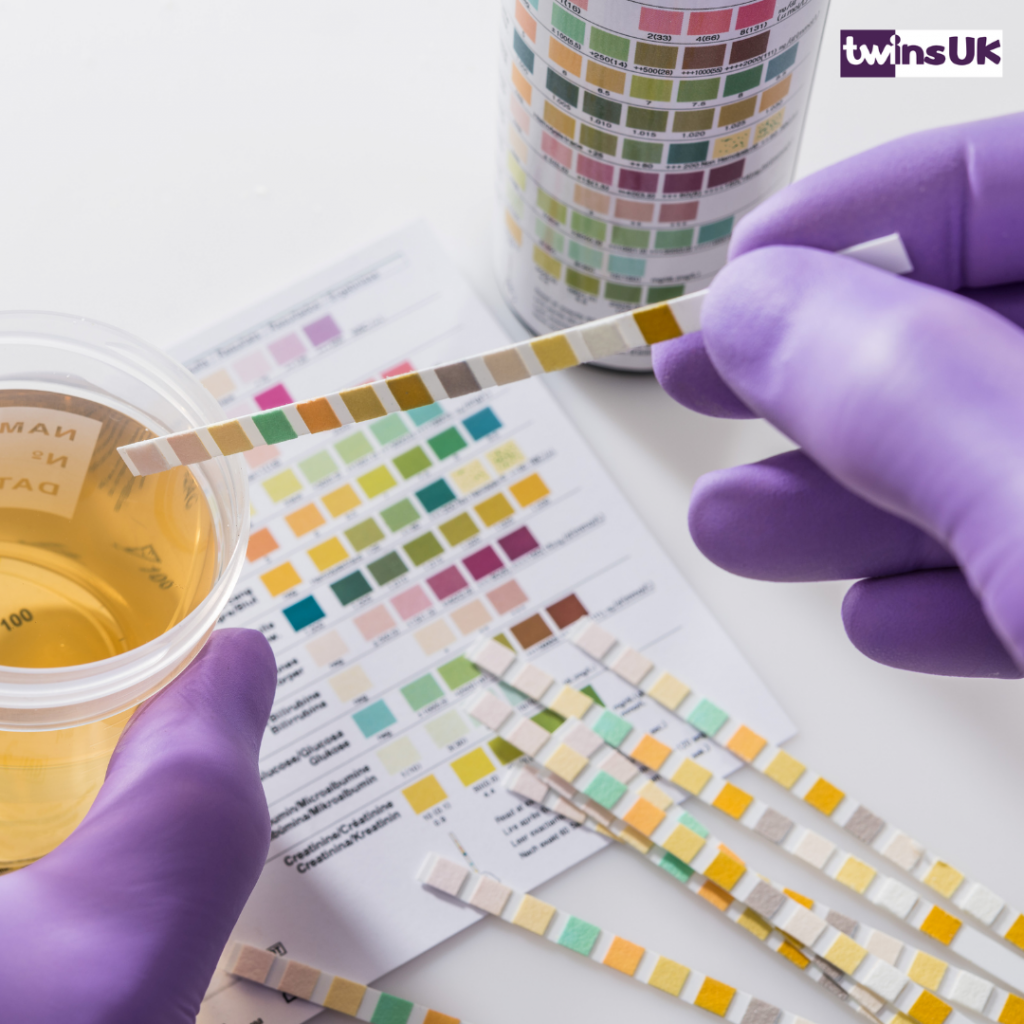
Urine test could offer new window into gut microbiome health
27th August 2026 – by TwinsUK
Researchers at King’s College London have identified a small group of molecules in urine that could help predict gut microbiome diversity, offering a potential new way to study gut health without relying on stool samples.
The research, published as a research letter, used data from 1,195 women in the TwinsUK cohort to investigate whether metabolites measured in urine could provide information about the composition and diversity of bacteria living in the gut.
The gut microbiome is increasingly recognised as an important part of human health, with changes in the diversity and abundance of gut bacteria associated with a range of health outcomes. However, studying the microbiome typically requires stool samples, which can be difficult or inconvenient to collect and can present challenges for large-scale research, particular in large biobanks where stool samples are often not routinely collected.
The researchers used urine metabolomics alongside detailed gut microbiome data generated through shotgun metagenomic sequencing. They then used machine-learning models to identify urinary metabolites that could help distinguish people with higher or lower levels of gut microbial diversity.
The analysis identified six urinary metabolites that could predict gut microbial diversity with similar performance to a much larger panel of hundreds of metabolites. The six-molecule panel showed good model discrimination (area under the curve, AUC=0.732) in distinguishing participants with higher and lower Shannon diversity, a commonly used measure of gut microbial diversity.
The researchers also identified 44 core bacterial species within the study population. Five species could be predicted from urine metabolites with an AUC above 70%, including Blautia wexlerae, Clostridia bacterium, Coprococcus eutactus and Faecalibacterium prausnitzii, and the uncultured species GGB9758 SGB15368.
Several of the most informative urinary molecules were linked to dietary or hormone-related processes. Cinnamoylglycine, the strongest predictor of overall gut microbial diversity, is associated with the microbial metabolism of dietary polyphenols. Other important metabolites included 11beta-hydroxyandrosterone sulfate, which is linked to hormone metabolism, and enterolactone sulfate, a metabolite produced through the microbial metabolism of dietary lignans.
Together, the findings highlight the close relationship between diet, host metabolism and the gut microbiome, and suggest that some of the metabolic signals associated with gut bacteria can be detected in urine.
Dr Cristina Menni, senior author of the study at King’s College London, said:
“Our findings suggest that urine contains measurable signals of the gut microbiome, and that we can capture information about microbial diversity using a relatively small number of metabolites. This is exciting because urine is much easier and less invasive to collect than stool, which could make this approach particularly valuable for large-scale population studies.”
First author Yu Lin, researcher at King’s College London, said:
“We were particularly interested to find that just six metabolites could predict gut microbial diversity with almost the same accuracy as hundreds of metabolites. Many of these molecules are connected to diet and hormone metabolism, showing how closely the gut microbiome interacts with the wider biology of the body.”
The researchers say the findings provide proof of concept that urine metabolomics could act as a non-invasive proxy for aspects of gut microbiome health. Unlike stool collection, urine samples are relatively simple to obtain, potentially making this approach useful for large population studies.
The study also demonstrates how the deeply characterised TwinsUK cohort can be used to bring together different types of biological data. By combining urine metabolomics with gut microbiome, health and demographic information, the researchers were able to investigate the connections between microbial diversity and the wider biology of the individual.
However, the researchers emphasise that further work is needed before urine metabolite testing could be used to assess gut health in clinical settings. The study focused exclusively on women, and the findings will need to be replicated in larger and more diverse populations, including people of different ages, sexes and ethnic backgrounds.
Dr Cristina Menni added:
“This is an important proof of concept, but we are not yet at the stage where a urine test can replace microbiome analysis. The next step is to validate these findings in larger and more diverse populations and to understand the biological mechanisms behind these associations.”
The findings suggest that urine could provide a new, accessible source of information about the gut microbiome. With further validation, urine-based approaches could support large-scale population research and potentially contribute to future ways of monitoring gut health without the need for stool sampling.
The research was supported by UKRI, the Chronic Disease Research Foundation and the Wellcome Trust, among other funders.